
PaleoID — well sample identification
BULKMAT 2.0 — the web edition of the BULKMAT program (P. Lesslar, XGS/1, Oct. 1984, modified from Sneath 1979).
PaleoID identifies well samples from their species content. Given a list of species observed in a sample, it compares the assemblage against an identification matrix — a knowledge base of taxa (depositional environments, foram bands or pollen zones) and the percentage of samples of each taxon in which every species occurs. For each sample it calculates the Willcox probability that the assemblage belongs to each taxon and lists the three most likely identifications.
The program is a web edition of the identification program by P. Lesslar (XGS/1, Oct. 1984), modified from Sneath (1979), and reproduces its results exactly. See Method & references for details.
The environmental scheme
The knowledge base (identification matrix) supplied with the program describes the North West Borneo environmental scheme developed by Sarawak Shell Berhad in the 1970s. The scheme divides the depositional realm into continental, coastal plain, coastal and marine environmental units, from tidal mangrove swamp and distributary channels through inner, middle and outer neritic (holomarine and fluviomarine) to bathyal. The taxa in the matrix (LCP, HINS, FINS, HIN, HINF, FIN, HMN, HMNF, FMN, HON, HONF, FON, O‑BAT) are the units of this scheme.
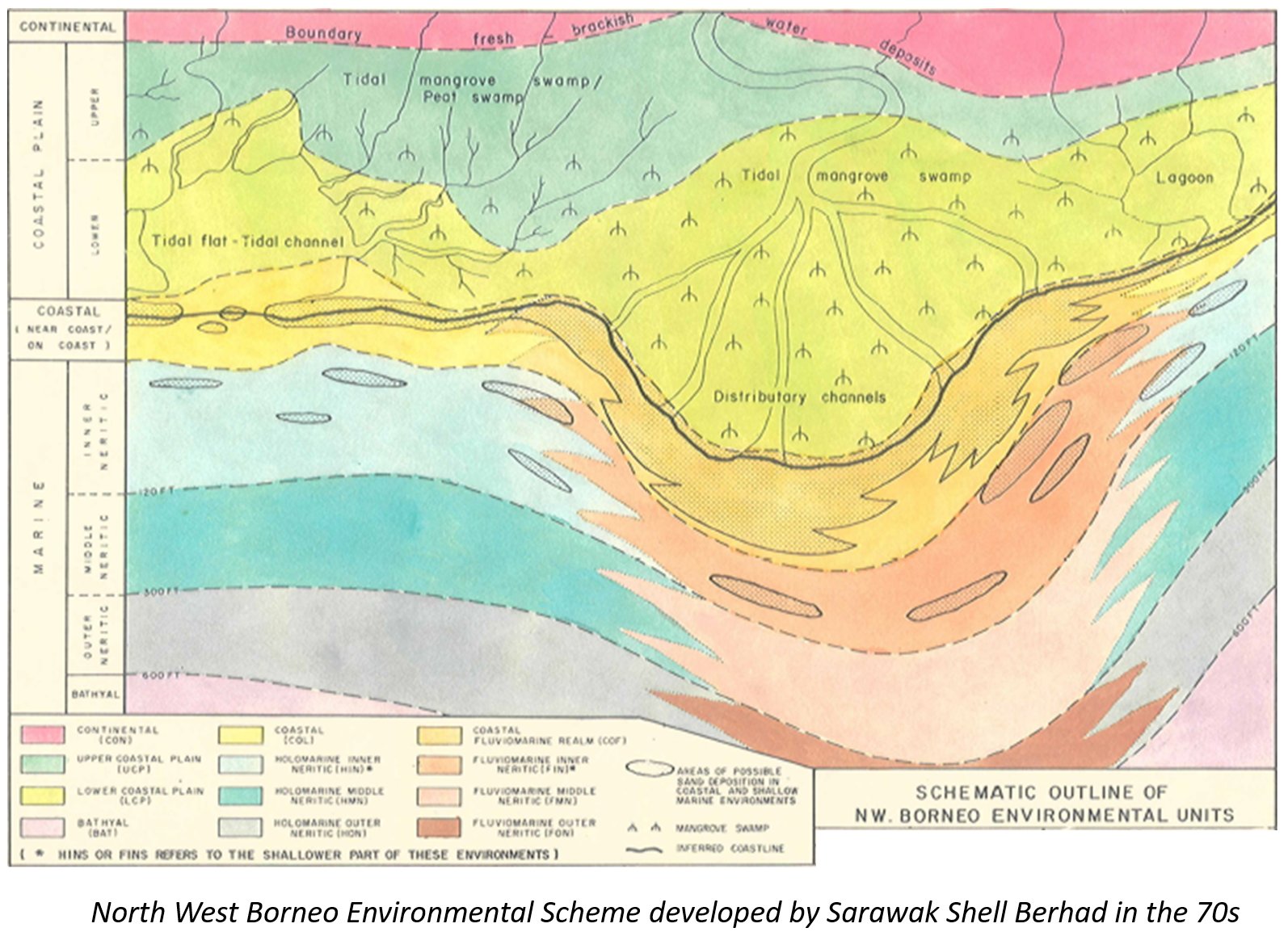
Schematic outline of the N.W. Borneo environmental units — the environmental scheme developed by Sarawak Shell Berhad in the 1970s, which the identification matrix describes. (HINS or FINS refers to the shallower part of the HIN resp. FIN environments.)
What the tool provides
- The three most likely identifications per sample, with Willcox probabilities
- The full probability distribution across all taxa in the matrix
- Diagnostic “species against” analysis: which species argue for or against each identification
- Species counts, positive matches, P/B ratio, Yule–Simpson and Fisher alpha diversity indices
- Scientific names from the FORLIST species list alongside the codes
- A downloadable report in the original program’s format
Access
The tool is free to use, but registration is required. Submitted samples and their results are logged: the data collected will be used to extend the identification knowledge base, which will improve the tool for everyone. Please read the short user guide before your first run.
Launch the identification tool